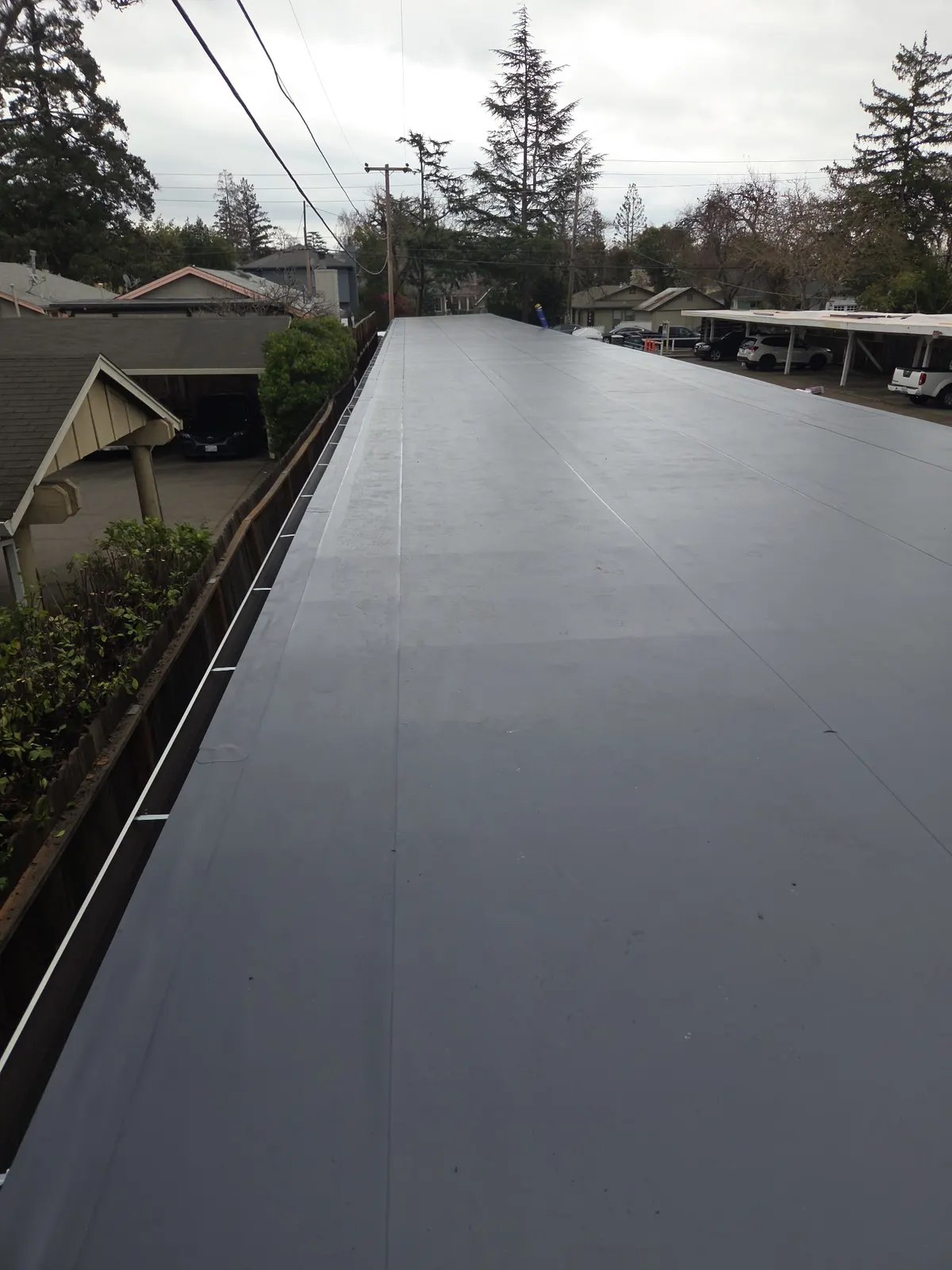
Flat roofing systems are common on California commercial buildings, modern residential designs, and home additions. Unlike sloped roofs, flat roofs require specialized membranes and drainage solutions. In Sonoma County's climate — hot, dry summers followed by heavy winter rain — choosing the right flat roofing system has a direct impact on energy costs, maintenance requirements, and longevity. Our commercial roofing team and new installation specialists work with all three primary flat roofing systems.
The Three Main Flat Roofing Systems
TPO (Thermoplastic Polyolefin)
TPO has become the most widely installed flat roofing membrane in California, and for good reason. Its white reflective surface is naturally energy-efficient — raising a roof's solar reflectance from the 10–20% typical of dark membranes to 60% or higher. This reduction in heat absorption can lower cooling energy consumption by 20% or more, a significant benefit in Sonoma County's warm summers.
TPO is heat-welded at the seams, creating a monolithic barrier that resists water infiltration. It is lightweight, UV-resistant, and typically more affordable than EPDM for large-area installations. TPO membranes come in 45-mil, 60-mil, and 80-mil thicknesses — for California's climate, 60-mil is the standard recommendation for residential applications.
EPDM (Ethylene Propylene Diene Monomer)
EPDM is a synthetic rubber membrane that has been used on flat roofs since the 1960s. It is renowned for its exceptional UV and ozone resistance, flexibility in temperature extremes, and 30+ year service life when properly maintained. EPDM is available in both black and white formulations — the white version provides reflectivity comparable to TPO.
One of EPDM's strongest attributes is its puncture resistance and ability to handle building movement without cracking. It is bonded to the roof deck with adhesive or mechanically fastened, and seams are sealed with tape or liquid adhesive. While installation is slightly more labor-intensive than TPO heat-welding, a properly installed EPDM membrane is extraordinarily durable.
Modified Bitumen
Modified bitumen is an evolution of traditional built-up roofing (BUR). It combines asphalt with polymer modifiers — typically SBS (styrene-butadiene-styrene) or APP (atactic polypropylene) — to create a flexible, multi-ply membrane system. SBS-modified bitumen is particularly flexible and works well in areas with temperature fluctuations. APP-modified bitumen offers superior UV resistance and is often used as a cap sheet in California applications.
Modified bitumen systems are typically installed in two or three plies, creating redundancy that protects against water penetration even if the top layer is punctured. They are torched down, cold-applied, or self-adhered depending on the product specification. This system excels in lower-slope applications where foot traffic during maintenance is expected.
Upgrading from a dark traditional membrane to a white TPO or EPDM system raises solar reflectance from 10–20% to 60%+, reducing cooling energy consumption by 20% or more.
Source: Lawrence Berkeley National Laboratory Cool Roofs Research
Flat Roofing Comparison: Which Is Right for You?
| System | Typical Lifespan | Best For | Energy Performance |
|---|---|---|---|
| TPO | 20–30 years | Commercial, large residential | Excellent (white reflective) |
| EPDM | 25–35+ years | Residential additions, low-slope | Good (white option available) |
| Modified Bitumen | 20–30 years | Multi-ply redundancy needed | Moderate (granulated surface) |
Flat Roof Maintenance in California's Climate
All flat roofing systems require more attentive maintenance than sloped roofs due to the reduced drainage gradient. Standing water (ponding) is the primary enemy of flat roof longevity — water that sits for more than 48 hours after rain accelerates membrane degradation and seam stress. We recommend professional inspection twice yearly: once in fall before the rainy season and once in spring after the heaviest rains have passed.
Key maintenance tasks include clearing drains and scuppers of debris, inspecting seams and flashings for separation, checking penetrations around HVAC units and vent stacks, and assessing membrane surface for blistering or cracking. Our team offers maintenance programs that keep your flat roof performing at peak efficiency throughout its service life.
Warranties and Financing
Sutter Roofing Systems offers workmanship warranties of 3, 5, or 10 years on flat roofing installations, backed by manufacturer warranties ranging from 10 to 50 years depending on the system and membrane thickness selected. Financing is available for qualifying projects — contact us to discuss options. Call us at (707) 829-5050 or request a free estimate online.